Pages

Friday, April 8, 2011

rose: love in violent times - inga muscio


Can I just say, I love Inga Muscio? I think I can, because it's unquestionably true. I loved cunt so much I've already read it twice.

rose is a kind of sequel to cunt. cunt was specific (specifically about cunts), microfeminism. rose is macro, the philosophy of cunt splashed worldwide. Muscio talks about violence, not just the kicking and shooting people kind, but the passive violence that seeps into every aspect of our lives, from deforestation to racism to celebrity. We are a violent people.

I'm still processing the book, I tore through it in two sittings so I'm still marinating. The way Muscio can transform a mildly awkward interaction with a neighbor into it's violent core and then contexualize that in both the culture of modern America and our collective history of colonization and war is amazing. In her world, feeding the goats that live behind her house becomes a radical act of love.

Reading Muscio is so inspiring, it (again) makes me put my life and my interactions with my world under the microscope. I can quiet the violence around me. I can walk away from hate and I can unconditionally love the assholes of the world. And now I'm gushing. I have no shame.

Everyone should read Muscio. The End.


In other news - next I'm picking up The Sicilian by Mario Puzo. I've been a little intense lately with the nonfiction so I'm returning to the saga of the Godfather. Still picking up pages here an there in Acid Dreams, but it's a little dry. (Which seems impossible, right? How do you make a story about the CIA experimenting with LSD boring? Maybe by overuse of the word "ironic".)


I love you, internet. And Miranda.

Tuesday, April 5, 2011

Bossypants by Tina Fey

"I hope that's not really the cover. That's really going to hurt sales." - Don Fey, Father of Tina fey

"Totally worth it." - Trees

You know a book is going to be awesome when even the blurbs on the back of the book are hilarious.

I've been a fan of Tina Fey for years, ever since she first started doing Weekend Update on SNL. This was back when I was young and still had the energy to stay awake past 10pm. She was a tiny, smart, funny brunette. I identified with her. I still do. She rocks the sexy librarian aesthetic by being smart and wearing glasses. I rock the same look by being an actual librarian.

The book is filled with tales from Tina's life, starting as a child growing up in Pennsylvania, through her time at Second City in Chicago (I have also been to Chicago! The similarities are endless), up to her current job as show runner and star of 30 Rock. The book is hilarious, filled with what I assume are the best stories from Fey's life. The book is really more a series of funny stories than a flat, "this happened and then this happened" autobiography, but you definitely get a sense of her life story.

Bossypants is a feminist book, because Fey is a feminists and a "woman in a man's world." Whatever that means. (Wouldn't it be nice if certain areas weren't viewed as a "man's world," but just as part of the world? I look forward to the day that a woman being the head writer for SNL is so commonplace that it doesn't get remarked upon.) Fey is living proof that feminists are not humorless, man-hating bitches. Here are her pointers for women trying to make it in a male-dominated workplace: "No pigtails, no tube tops. Cry sparingly. (Some people say "Never let them see you cry." I say if you're so mad you could just cry, then cry. It terrifies everyone.) When choosing sexual parters, remember: Talent is not sexually transmittable. Also, don't eat diet foods in meetings." Those are wise words, my friend. I work in a female dominated workplace, but these are still applicable to my life.

Obviously, I freaking loved this book. We're getting married, and Abby has agreed to become internet-ordained in order to perform the ceremony. You should absolutely read it, it's quick, funny, smart, silly. You'll probably love it just as much as I do, but you can't marry it because I beat you to it and I'm not into bigamy.

I know I already made it quite clear that I identify with and look up to Tina Fey, but there was one passage in the book that made me feel like I might secretly be Tina Fey. While listing off her faults: "I have no affinity for animals. I don't hate animals and I would never hurt an animal; I just don't actively care about them. When a coworker shows me cute pictures of her dog, I struggle to respond correctly, like an autistic person who has been taught to recognize human emotions from flash cards. In short, I am the worst." Yup. That's me. I'm a cat person, which means I like it when my pets pretty much hate me and leave me alone until they want to be fed. I also like goldfish because they never want to cuddle. That actually explains a lot about me. I am the worst.

Sunday, April 3, 2011

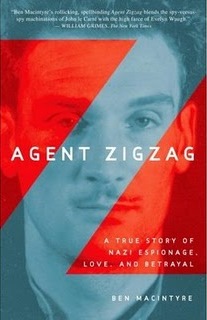
Agent Zigzag - Ben Macintyre


Agent Zigzag: A True Story of Nazi Espionage, Love, and Betrayal

and so it is. Agent Zigzag is the story of Eddie Chapman, an English gentleman thief who talked his way out of prison in German-occupied France by becoming a German spy then immediately turned double-agent for Britain.

I quite enjoyed this book. Macintyre found most of the story in recently declassified documents, which gives this outrageous story a strong anchor. It's a deep look at WWII espionage, counterespionage, technology and psychology, but never dull. Chapman is truly a character made for movies - explosives, bank robbery, beautiful women, expensive taste, cover stories and sabotage. And yet often Chapman is restless and bored.

For anybody who likes a spy story (or the tv show Alias) or WWII trivia, this is a must-read. The story is well-written and most of the auxiliary characters are really well fleshed out. Plus there's a certain schadenfreude for the reader as upstanding government employees are compelled to provide a valuable spy with "loose women". The English are appropriately scandalized.

Chapman provided an astounding amount of valuable intelligence to the English at a crucial time in the war and was able to provide just as much valuable misinformation to the Germans, directing bombs away from central London and misleading them about the Allies technological capabilities.

Despite his amazing contribution to the war effort, Chapman was a con man and he was never fully trusted by his British handlers. Macintyre kind of obsesses over Chapman as a psychological study (as did the Germans and the Brits in their time), a man who will "look you straight in the eye while picking your pocket". He's an opportunist, for sure, but at a time of great need he was a patriot. His story is one worth reading, and it seems that Chapman himself would strongly agree.

Macintyre published another book about WWII last year called Operation Mincemeat which made Amazon.com's Top 100 Books of 2010. When I get through the backlog I'll definitely pick that up. At the moment I'm in the middle of Personal History, Katherine Graham's autobiography, two chapters into Acid Dreams, the complete social history of LSD, and I'm quickly consuming Rose by Inga Muscio. Clearly, I lack focus.

Monday, March 21, 2011

Finishing "Poplorica." Sort of.

This may be the first time I have ever accidentally finished a book. I was sitting there last night, Poplorica in hand, reading a really interesting chapter about product placement in movies. It might have been my favorite chapter in the book. The next chapter was about the invention of a certain golf club driver. I don't know if the chapter was as boring as it sounded, because I decided to skip it. The golf club chapter starts on page 225 of 284, so I thought I still had another chapter to read. Turns out those last 60 some pages are all chapter notes and index. I thought about going back to read the golf club chapter just so I could say I read the whole book, but the overwhelming boringness of golf persuaded me to just call it a day.

The boringness of golf leads me to the point I want to make about this book: your enjoyment of it is directly related to your interest level in the subject matter. As a Mad Men fan, I enjoyed the chapters about the birth of product-placement and market research. Reading how these now commonplace marketing strategies were started was really interesting. Also extremely interesting were the chapters about Night of the Living Dead, graphical user interfaces, and tabloids. Even the chapter about the slam dunk and how it shaped the NBA carried a certain amount of nostalgia. As a kid growing up in Chicagoland in the '90s when The Bulls were Gods, everyone liked basketball. That chapter brought back memories of watching games with my dad, watching Michael Jordan soar to the basket.

Other chapters were less interesting. Seriously, who cares about golf? (Yes, I know. Abby's husband golfs. He would probably like that chapter.) After reading Bonk, the chapter on Kinsey seemed really light. And I get where they were going with the chapter on pantyhose, but I think a chapter about bras would have been more interesting. How did we go from longline bras and girdles to modern bras? From custom-fit to ABCs? I also think discussing the invention of the birth control pill would have been fantastic. As it is the chapters that talk about women's liberation are the ones about frozen dinners, pantyhose, and disposable diapers. I know I'm biased, but I would have loved more chapters about women and society.

Overall it was a good book. It was easy to read and well researched. Definitely worth the $1 I paid for it.

Friday, March 18, 2011

The Graduate - Charles Webb

I picked up this classic several months ago at an antique store. I think I paid $2 for the 1963 hardcover edition. It has an inscription To Susie ~ xmas 1969 ~ From Katie Yeatts. I love inscriptions. Note to self, write shit on the first page of all those books you give as gifts.

So! It's a classic, I think everyone is familiar with the plot either from the book, the film or the Simon & Garfunkel song. No need to dwell on it.

Charles Webb's style is distinctive, very minimalist. Not Hemingway-sparse, but the language isn't flowery and he doesn't waste pages on the touchy-feely bits. In fact the story is told from a 3rd-person objective point of view and the narration only follows our dubious protagonist Benjamin Braddock. The effect, for me at least, lent to the idea that young Ben has no idea what the hell he's doing with his life. He's never able to properly explain himself to anyone and he acts with seeming disregard for, or possibly unawareness of, his relationship to his world.

The cover advertises hilarity, which I think is an overstatement as most of the humor is quite understated. Actually some of it felt really stale, but I imagine it's because it's been frequently copied. Not to spoil the story, but somebody's gonna break up a wedding. It is funny though, and easily worth the short 191 pages that it sets you back. One of my favorite funny things is the fact that months into their affair Braddock is still addressing to his lover as Mrs. Robinson. Hee.

The theme though is a bit dark in a quaint "what does it all mean" way, which I'm inclined to appreciate. The characters all seem weighed down by their upper middle class lifestyles and intellectual boredom, but that stiffness in no way drags on the story. I also like Webb's resistance to judging his characters for their actions. Though he certainly suffers the inevitable consequences of his decisions, Braddock is never written off as a villain or a boy in need of saving. He just is who he is.

On a slightly different note, I'm finding that a lot of "modern literature" is starting to feel really dated to me. Benji Braddock watches TV until the stations stop broadcasting. Anything that happened before the invention of infomercials seems like it would have little bearing on my life.

Sunday, February 27, 2011

The Children of Henry VIII by Alison Weir

Barnes & Noble's 'buy 2 get the third half price' rack provided me with several fun reads recently. For someone with a kind of weird obsession with medieval European royalty this book did not disappoint.

Weir tells a well-known story from a fresh perspective. The exploits of Henry VIII and his six wives and the rein of his eventual heir, Queen Elizabeth, are well-documented in film and television. The childhoods and relationships between Henry's three children, however are less common knowledge.

The book chronicles the childhoods of Anne, Edward and Elizabeth as well as their cousin Jane Grey. It follows the lives of each child and their tenuous relationships with each other from the time of Henry's death through Elizabeth's ascension to the throne.

What fascinated me is the sense of isolation - even when each was on the throne they were without true, loyal friends. Everybody around them was constantly trying to manipulate and control them for their own ends. There was never a time when they really knew who they could trust. Those in line for the throne feared for their lives constantly (and with good reason - Jane Grey was put to death and Anne's advisors lobbied strongly for Elizabeth to meet the same end). The crazy religious upheaval of the time, the youth of the prince and princesses, and the lack of trust between them all make for compelling drama.

The book is an entertaining read, Weir has lots of first-hand accounts and quotes which bring the characters to life and humanize them. And at the end of the day it reminds you how lucky we are to have modern medicine, video and religious freedom. The fate of the British Empire would most certainly have changed if they only had the information we get by peeing on a stick.

Thursday, January 13, 2011

Poplorica by Martin J. Smith and Patrick J. Kiger


I know it looks like I must have developed a life or something over the last few months, because I haven't posted any book reviews here since early November. I assure you this is not the case. I haven't actually finished reading anything recently, but since there's nothing I love more than procrastinating on finishing my grad school applications, I'm here tonight to post about the book I'm currently reading, Poplorica.

I picked up Poplorica for a dollar off a Borders clearance rack years ago. I had completely forgotten about it until I pulled it out of a big box of books I rescued from my old bedroom at my parents' house. I started reading it last week and so far I'm really enjoying it. It's got a great balance of history and humor. It's well-researched without being heavy and boring. I've finished the first four chapters, which were about front lawns, air conditioning, calorie counting, and Alfred Kinsey. The purpose of the book is to look at the small inventions or ideas that lead to bigger movements and are still influencing our society today. Like how a landscape design book from 1870 praising grass lawns lead to nearly every household in America having a lawn, despite the fact that most Americans hate yard work. How Alfred Kinsey's unsuccessful honeymoon lead to his research that helped fuel the sexual revolution. How the invention of air conditioning prompted a population boom in the more conservative Southern states, shifting the votes in the Electoral College for each state and therefor influencing national elections.

It's an interesting book, and the chapters are nice and short (about ten pages each). I'll let y'all know how the rest of the book was when I'm finished. The next chapter is "The Rise of Tacky Chic" and I am pumped. There's nothing I love more than a little tack mixed in with my chic.